Finding the Slope of a Line if You Know a Point It Runs Through
Learning Objectives
- Notice the Slope from a Graph
- Place rise and run from a graph
- Distinguish between graphs of lines with negative and positive slopes
- Detect the Slope from Two Points
- Apply the formula for slope to define the slope of a line through two points
- Find the Slope of Horizontal and Vertical Lines
- Notice the slope of the lines [latex]x=a[/latex] and [latex]y=b[/latex]
- Recognize that horizontal lines have slope = 0
- Recognize that vertical lines have slopes that are undefined
- Identify slopes of parallel and perpendicular lines
- Given a line, identify the slope of some other line that is parallel to information technology
- Given a line, place the slope of another line that is perpendicular to it
- Translate slope in equations and graphs
- Verify the slope of a linear equation given a dataset
- Translate the slope of a linear equation as information technology applies to a existent situation
Place slope from a graph
The mathematical definition of slope is very like to our everyday one. In math, slope is used to depict the steepness and direction of lines. By just looking at the graph of a line, you can learn some things about its slope, especially relative to other lines graphed on the same coordinate plane. Consider the graphs of the 3 lines shown below:
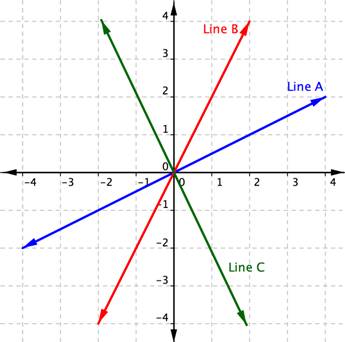
Offset, permit'south look at lines A and B. If you imagined these lines to be hills, yous would say that line B is steeper than line A. Line B has a greater slope than line A.
Next, detect that lines A and B slant up equally y'all move from left to right. We say these two lines accept a positive slope. Line C slants down from left to right. Line C has a negative gradient. Using two of the points on the line, you can notice the slope of the line by finding the ascent and the run. The vertical modify between ii points is called the rise, and the horizontal alter is called the run. The slope equals the rise divided by the run: [latex] \displaystyle \text{Slope }=\frac{\text{rise}}{\text{run}}[/latex].
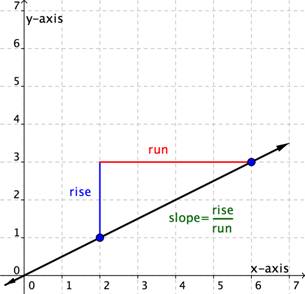
You can determine the slope of a line from its graph by looking at the rise and run. Ane characteristic of a line is that its slope is constant all the way along it. So, you tin choose whatsoever 2 points forth the graph of the line to figure out the slope. Let's look at an example.
Example
Use the graph to detect the slope of the line.
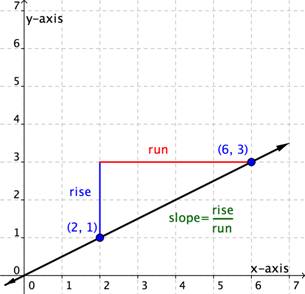
This line volition take a gradient of [latex] \displaystyle \frac{ane}{two}[/latex] no matter which ii points you lot selection on the line. Try measuring the slope from the origin, [latex](0,0)[/latex], to the point [latex](6,3)[/latex]. You will observe that the [latex]\text{ascension}=3[/latex] and the [latex]\text{run}=6[/latex]. The slope is [latex] \displaystyle \frac{\text{ascension}}{\text{run}}=\frac{iii}{half dozen}=\frac{1}{2}[/latex]. It is the same!
Let'due south look at another example.
Example
Employ the graph to find the slope of the 2 lines.
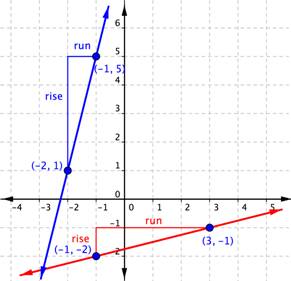
When you await at the two lines, you lot can see that the blue line is steeper than the red line. It makes sense the value of the slope of the blue line, 4, is greater than the value of the slope of the red line, [latex] \displaystyle \frac{1}{4}[/latex]. The greater the gradient, the steeper the line.
Finding the Slope of a Line From a Graph
Distinguish between graphs of lines with negative and positive slopes
Management is important when information technology comes to determining gradient. Information technology'southward important to pay attending to whether you lot are moving up, down, left, or right; that is, if you lot are moving in a positive or negative direction. If you lot go upward to get to your 2nd signal, the ascension is positive. If you go down to get to your 2nd point, the rise is negative. If you go correct to get to your second bespeak, the run is positive. If you become left to get to your second point, the run is negative.
In the following 2 examples, you will meet a slope that is positive and one that is negative.
Example (Advanced)
Notice the gradient of the line graphed below.
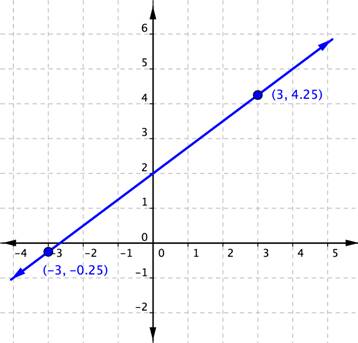
The next example shows a line with a negative slope.
Example
Find the gradient of the line graphed below.
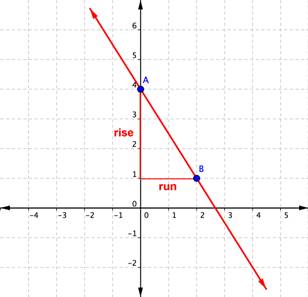
In the instance to a higher place, you could have found the slope past starting at indicate B, running [latex]{-ii}[/latex], and then rising [latex]+3[/latex] to arrive at signal A. The upshot is still a slope of [latex]\displaystyle\frac{\text{rise}}{\text{run}}=\frac{+3}{-2}=-\frac{3}{two}[/latex].
Finding the Gradient from 2 Points on the Line
You've seen that yous can find the slope of a line on a graph by measuring the ascent and the run. Y'all tin can also find the slope of a straight line without its graph if you know the coordinates of any two points on that line. Every signal has a ready of coordinates: an x-value and a y-value, written as an ordered pair (x, y). The x value tells you where a bespeak is horizontally. The y value tells you where the betoken is vertically.
Consider 2 points on a line—Point i and Point ii. Betoken ane has coordinates [latex]\left(x_{1},y_{1}\correct)[/latex] and Point 2 has coordinates [latex]\left(x_{two},y_{2}\right)[/latex].
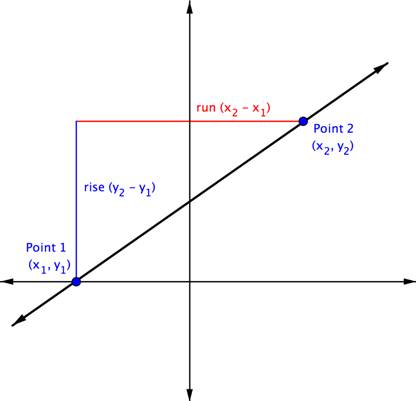
The rise is the vertical distance between the two points, which is the departure between their y-coordinates. That makes the rise [latex]\left(y_{2}-y_{1}\right)[/latex]. The run between these two points is the divergence in the x-coordinates, or [latex]\left(x_{ii}-x_{1}\right)[/latex].
Then, [latex] \displaystyle \text{Gradient}=\frac{\text{rise}}{\text{run}}[/latex] or [latex] \displaystyle k=\frac{{{y}_{2}}-{{y}_{1}}}{{{ten}_{2}}-{{x}_{1}}}[/latex]
In the instance beneath, y'all'll come across that the line has two points each indicated as an ordered pair. The point [latex](0,2)[/latex] is indicated as Point 1, and [latex](−two,6)[/latex] as Point 2. And then you are going to move from Point ane to Signal two. A triangle is drawn in to a higher place the line to help illustrate the ascent and run.
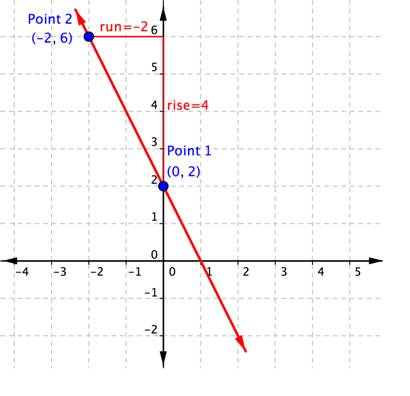
You lot can meet from the graph that the rise going from Bespeak 1 to Point two is iv, because y'all are moving iv units in a positive direction (upward). The run is [latex]−2[/latex], because you lot are then moving in a negative direction (left) two units. Using the slope formula,
[latex] \displaystyle \text{Slope}=\frac{\text{rise}}{\text{run}}=\frac{4}{-two}=-2[/latex].
You exercise non demand the graph to find the gradient. You can just use the coordinates, keeping careful rail of which is Signal 1 and which is Point 2. Let's organize the information about the ii points:
| Name | Ordered Pair | Coordinates |
|---|---|---|
| Bespeak one | [latex](0,ii)[/latex] | [latex]\begin{array}{fifty}x_{one}=0\\y_{1}=2\terminate{array}[/latex] |
| Point 2 | [latex](−2,6)[/latex] | [latex]\begin{array}{l}x_{ii}=-2\\y_{2}=6\end{array}[/latex] |
The gradient, [latex]m=\frac{y_{2}-y_{1}}{x_{2}-x_{1}}=\frac{6-2}{-2-0}=\frac{4}{-two}=-2[/latex]. The slope of the line, m, is [latex]−2[/latex].
It doesn't thing which indicate is designated as Point 1 and which is Point 2. You could have chosen [latex](−2,vi)[/latex] Point ane, and [latex](0,2)[/latex] Signal 2. In that case, putting the coordinates into the slope formula produces the equation [latex]yard=\frac{2-6}{0-\left(-2\right)}=\frac{-4}{2}=-two[/latex]. Once once more, the gradient is [latex]g=-2[/latex]. That'southward the same gradient equally before. The important thing is to be consistent when y'all subtract: you must always decrease in the same society [latex]\left(y_{ii},y_{1}\right)[/latex]and [latex]\left(x_{2},x_{1}\right)[/latex].
Example
What is the gradient of the line that contains the points [latex](v,5)[/latex] and [latex](4,2)[/latex]?
The example below shows the solution when you reverse the order of the points, calling [latex](5,v)[/latex] Betoken ane and [latex](4,2)[/latex] Point ii.
Example
What is the slope of the line that contains the points [latex](5,5)[/latex] and [latex](four,2)[/latex]?
Notice that regardless of which ordered pair is named Point 1 and which is named Signal 2, the slope is nonetheless 3.
Example (Advanced)
What is the slope of the line that contains the points [latex](3,-six.25)[/latex] and [latex](-1,8.5)[/latex]?
Permit's consider a horizontal line on a graph. No affair which 2 points y'all choose on the line, they will always have the same y-coordinate. The equation for this line is [latex]y=three[/latex]. The equation tin can as well be written every bit [latex]y=\left(0\right)x+3[/latex].
Video: Finding the Slope of a Line Given Two Points on the Line
Finding the Slopes of Horizontal and Vertical Lines
So far you've considered lines that run "uphill" or "downhill." Their slopes may exist steep or gradual, merely they are always positive or negative numbers. But there are two other kinds of lines, horizontal and vertical. What is the slope of a flat line or level footing? Of a wall or a vertical line?
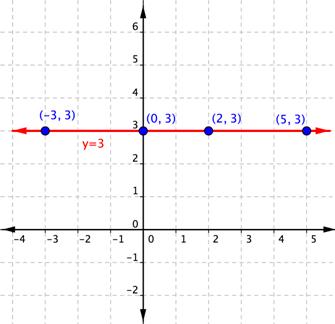
Using the course [latex]y=0x+3[/latex], you can see that the slope is 0. You can as well utilize the slope formula with two points on this horizontal line to summate the slope of this horizontal line. Using [latex](−3,3)[/latex] as Point one and (2, 3) as Point two, you become:
[latex] \displaystyle \begin{assortment}{l}yard=\frac{{{y}_{2}}-{{y}_{1}}}{{{x}_{2}}-{{x}_{1}}}\\\\m=\frac{three-3}{2-\left(-3\right)}=\frac{0}{5}=0\end{array}[/latex]
The slope of this horizontal line is 0.
Let'southward consider any horizontal line. No matter which two points you choose on the line, they will always have the same y-coordinate. And then, when you utilize the slope formula, the numerator volition ever exist 0. Zero divided by any non-aught number is 0, and then the slope of any horizontal line is ever 0.
The equation for the horizontal line [latex]y=3[/latex] is telling you that no matter which two points you choose on this line, the y-coordinate will ever be 3.
How about vertical lines? In their example, no matter which ii points you choose, they will ever have the same x-coordinate. The equation for this line is [latex]x=2[/latex].
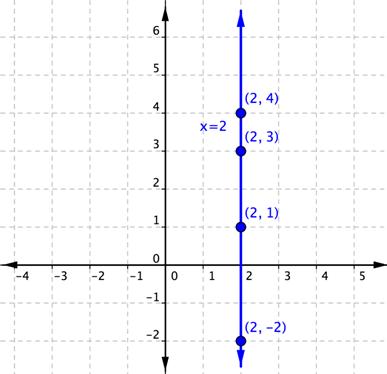
There is no way that this equation tin can be put in the slope-point form, as the coefficient of y is [latex]0\left(x=0y+2\correct)[/latex].
So, what happens when yous use the slope formula with two points on this vertical line to summate the slope? Using [latex](two,1)[/latex] as Point one and [latex](two,3)[/latex] every bit Point 2, you get:
[latex] \displaystyle \begin{array}{l}m=\frac{{{y}_{2}}-{{y}_{1}}}{{{ten}_{2}}-{{ten}_{1}}}\\\\thousand=\frac{iii-1}{2-2}=\frac{2}{0}\cease{array}[/latex]
But division by nil has no significant for the prepare of real numbers. Because of this fact, it is said that the slope of this vertical line is undefined. This is true for all vertical lines—they all have a gradient that is undefined.
Example
What is the slope of the line that contains the points [latex](3,2)[/latex] and [latex](−viii,two)[/latex]?
Finding Slopes of Horizontal and Vertical Lines
Narrate the slopes of parallel and perpendicular lines
When you graph 2 or more linear equations in a coordinate airplane, they generally cross at a point. Even so, when 2 lines in a coordinate plane never cross, they are called parallel lines. Yous will as well expect at the instance where two lines in a coordinate plane cross at a right angle. These are called perpendicular lines. The slopes of the graphs in each of these cases accept a special relationship to each other.
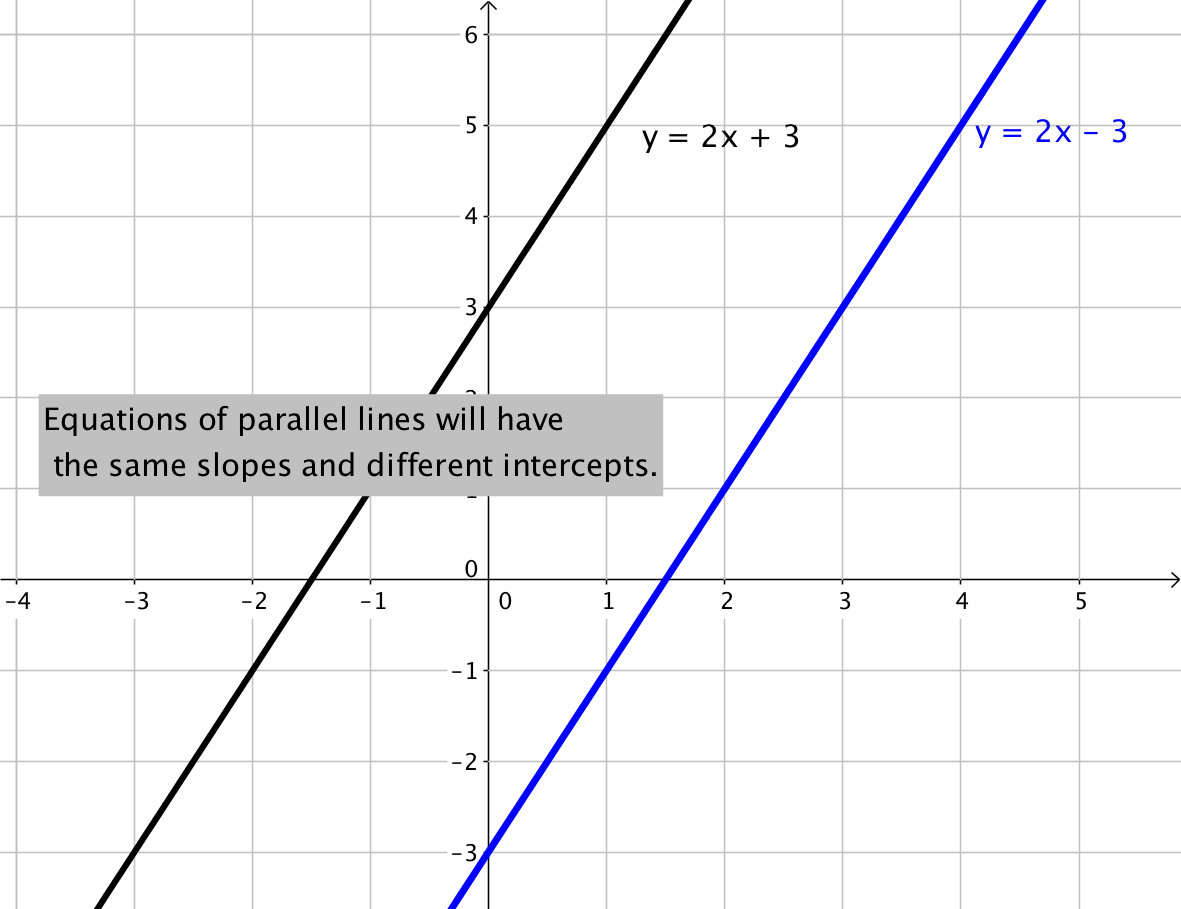
Parallel lines are two or more lines in a aeroplane that never intersect. Examples of parallel lines are all around us, such as the opposite sides of a rectangular picture frame and the shelves of a bookcase.
Perpendicular lines are ii or more lines that intersect at a 90-caste angle, like the two lines drawn on this graph. These 90-degree angles are as well known equally right angles.
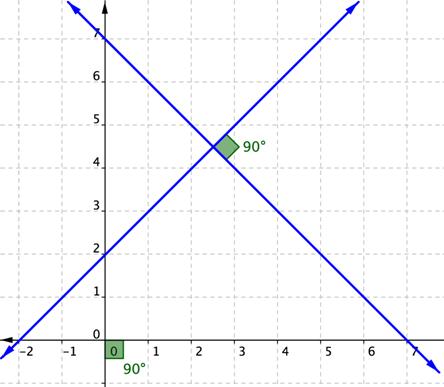
Perpendicular lines are also everywhere, non simply on graph paper only also in the world around u.s., from the crossing blueprint of roads at an intersection to the colored lines of a plaid shirt.
Parallel Lines
Two not-vertical lines in a plane are parallel if they have both:
- the same slope
- unlike y-intercepts
Whatever two vertical lines in a plane are parallel.
Example
Notice the slope of a line parallel to the line [latex]y=−3x+four[/latex].
Example
Determine whether the lines [latex]y=6x+5[/latex] and [latex]y=6x–1[/latex] are parallel.
Perpendicular Lines
Ii non-vertical lines are perpendicular if the slope of 1 is the negative reciprocal of the gradient of the other. If the gradient of the first equation is iv, then the slope of the second equation will need to be [latex]-\frac{1}{4}[/latex] for the lines to be perpendicular.
You can likewise cheque the two slopes to run into if the lines are perpendicular by multiplying the 2 slopes together. If they are perpendicular, the product of the slopes volition be [latex]−1[/latex]. For example, [latex] 4\cdot-\frac{ane}{4}=\frac{four}{1}\cdot-\frac{one}{4}=-one[/latex].
Instance
Discover the slope of a line perpendicular to the line [latex]y=2x–6[/latex].
To find the gradient of a perpendicular line, find the reciprocal, [latex] \displaystyle \tfrac{1}{2}[/latex], and then find the opposite of this reciprocal [latex] \displaystyle -\tfrac{ane}{two}[/latex].
Note that the product [latex]ii\left(-\frac{1}{2}\right)=\frac{two}{1}\left(-\frac{one}{2}\right)=-1[/latex], and then this means the slopes are perpendicular.
In the case where one of the lines is vertical, the slope of that line is undefined and information technology is not possible to calculate the product with an undefined number. When one line is vertical, the line perpendicular to it will be horizontal, having a slope of zero ([latex]m=0[/latex]).
Example
Determine whether the lines [latex]y=−8x+5[/latex] and [latex] \displaystyle y\,\text{=}\,\,\frac{1}{8}10-1[/latex] are parallel, perpendicular, or neither.
The Slope of Parallel and Perpendicular Lines
Verify Slope From a Dataset
Massive amounts of information is being collected every day by a wide range of institutions and groups. This data is used for many purposes including business organization decisions nearly location and marketing, government decisions nigh allocation of resources and infrastructure, and personal decisions well-nigh where to live or where to purchase nutrient.
In the post-obit example, you will see how a dataset tin exist used to define the slope of a linear equation.
Case
Given the dataset, verify the values of the slopes of each equation.
Linear equations describing the change in median domicile values between 1950 and 2000 in Mississippi and Hawaii are as follows:
Hawaii: [latex]y=3966x+74,400[/latex]
Mississippi:[latex]y=924x+25,200[/latex]
The equations are based on the post-obit dataset.
x = the number of years since 1950, and y = the median value of a house in the given state.
| Year (x) | Mississippi House Value (y) | Hawaii House Value (y) |
|---|---|---|
| 0 | $25,200 | $74,400 |
| 50 | $71,400 | $272,700 |
The slopes of each equation tin exist calculated with the formula you learned in the section on gradient.
[latex] \displaystyle grand=\frac{{{y}_{2}}-{{y}_{1}}}{{{10}_{ii}}-{{x}_{1}}}[/latex]
Mississippi:
| Name | Ordered Pair | Coordinates |
|---|---|---|
| Point one | (0, 25,200) | [latex]\brainstorm{array}{l}x_{i}=0\\y_{1}=25,200\stop{array}[/latex] |
| Betoken ii | (fifty, 71,400) | [latex]\brainstorm{assortment}{l}x_{2}=50\\y_{2}=71,400\end{array}[/latex] |
[latex] \displaystyle m=\frac{{71,400}-{25,200}}{{50}-{0}}=\frac{{46,200}}{{50}} = 924[/latex]
We have verified that the gradient [latex] \displaystyle thou = 924[/latex] matches the dataset provided.
Hawaii:
| Name | Ordered Pair | Coordinates |
|---|---|---|
| Point 1 | (0, 74,400) | [latex]\begin{array}{fifty}x_{one}=1950\\y_{ane}=74,400\end{assortment}[/latex] |
| Bespeak two | (50, 272,700) | [latex]\begin{array}{50}x_{ii}=2000\\y_{ii}=272,700\end{assortment}[/latex] |
[latex]\displaystyle m=\frac{{272,700}-{74,400}}{{l}-{0}}=\frac{{198,300}}{{50}} = 3966[/latex]
We have verified that the gradient [latex] \displaystyle k = 3966[/latex] matches the dataset provided.
Example
Given the dataset, verify the values of the slopes of the equation.
A linear equation describing the modify in the number of high school students who smoke, in a group of 100, between 2011 and 2015 is given as:
[latex]y = -ane.75x+sixteen[/latex]
And is based on the data from this tabular array, provided by the Centers for Affliction Command.
x = the number of years since 2011, and y = the number of high school smokers per 100 students.
| Year | Number of High Schoolhouse Students Smoking Cigarettes (per 100) |
| 0 | 16 |
| 4 | 9 |
| Proper noun | Ordered Pair | Coordinates |
|---|---|---|
| Point 1 | (0, xvi) | [latex]\begin{array}{l}x_{ane}=0\\y_{i}=16\end{array}[/latex] |
| Point 2 | (4, ix) | [latex]\begin{array}{l}x_{ii}=iv\\y_{ii}=ix\end{assortment}[/latex] |
[latex] \displaystyle m=\frac{{{y}_{ii}}-{{y}_{1}}}{{{x}_{2}}-{{10}_{1}}}=\frac{{9-16}}{{iv-0}} =\frac{{-7}}{{4}}=-1.75[/latex]
Nosotros take verified that the slope [latex] \displaystyle{m=-1.75}[/latex] matches the dataset provided.
Interpret the Slope of Linear Equation
Okay, now nosotros have verified that data tin provide us with the slope of a linear equation. So what? We can use this data to describe how something changes using words.
First, let's review the different kinds of slopes possible in a linear equation.
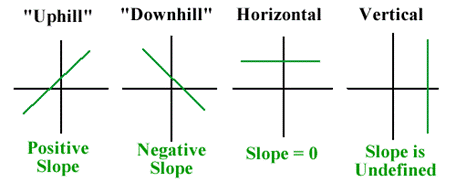
We often use specific words to describe the different types of slopes when we are using lines and equations to represent "existent" situations. The post-obit tabular array pairs the type of slope with the common language used to describe it both verbally and visually.
| Type of Slope | Visual Description | Exact Description |
| positive | uphill | increasing |
| negative | downhill | decreasing |
| 0 | horizontal | constant |
| undefined | vertical | N/A |
Case
Translate the gradient of each equation for business firm values using words.
Hawaii: [latex]y = 3966x+74,400[/latex]
Mississippi:[latex]y = 924x+25,200[/latex]
Translate the Pregnant of the Slope Given a Linear Equation—Median Home Values
Case
Translate the slope of the line describing the alter in the number of high school smokers using words.
Utilize units to the formula for slope. The ten values represent years, and the y values correspond the number of smokers. Remember that this dataset is per 100 high school students.
[latex] \displaystyle m=\frac{{9-sixteen}}{{2015-2011}} =\frac{{-7 \text{ smokers}}}{{four\text{ twelvemonth}}}=-i.75\frac{\text{ smokers}}{\text{ year}}[/latex]
The gradient of this linear equation is negative, so this tells us that in that location is a decrease in the number of high school age smokers each year.
The number of high schoolers that smoke decreases by 1.75 per 100 each year.
Interpret the Pregnant of the Slope of a Linear Equation—Smokers
On the next folio, we will see how to interpret the y-intercept of a linear equation, and make a prediction based on a linear equation.
Summary
Slope describes the steepness of a line. The gradient of any line remains abiding along the line. The slope tin can likewise tell you information about the management of the line on the coordinate plane. Slope can be calculated either by looking at the graph of a line or by using the coordinates of any two points on a line. There are 2 mutual formulas for gradient: [latex] \displaystyle \text{Slope }=\frac{\text{rise}}{\text{run}}[/latex] and [latex] \displaystyle m=\frac{{{y}_{2}}-{{y}_{ane}}}{{{10}_{2}}-{{x}_{1}}}[/latex] where [latex]one thousand=\text{slope}[/latex] and [latex] \displaystyle ({{x}_{i}},{{y}_{i}})[/latex] and [latex] \displaystyle ({{x}_{2}},{{y}_{two}})[/latex] are two points on the line.
The images below summarize the slopes of different types of lines.
hardawayliker1951.blogspot.com
Source: https://courses.lumenlearning.com/suny-beginalgebra/chapter/read-or-watch-find-slope-from-a-graph/
0 Response to "Finding the Slope of a Line if You Know a Point It Runs Through"
Post a Comment